The METEL study
Dying is a natural process. We want to recognise it in time.
METEL is a UK research study looking for natural changes in urine that show when a person with cancer is entering the last weeks of life, so that the care people receive at the end of life can be as good as it can be.
We can measure almost everything in medicine, except this
We have tests that tell us when someone is pregnant, having a heart attack, or fighting an infection. Yet for the last weeks of life, one of the few things that happens to every one of us, there is no test at all. Doctors and nurses rely on experience and judgement. Often that judgement is right. Sometimes the signs are only clear in hindsight.
When dying is recognised late, people can lose precious time. Treatments that no longer help may carry on. Families may not get the chance to be together, to say what they want to say, or to plan the kind of care their person would choose.
In the 21st century, we still do not understand the biology of dying. We believe that has to change.
Our work starts from a simple idea: dying is not a single moment. It is a process, and the body changes in recognisable ways as it unfolds. If we can measure those changes, we can help teams recognise them sooner and give people the care they need, at the right time.
What METEL is doing
METEL stands for Metabolites Towards the End of Life. Metabolites are small molecules the body makes as it goes about its work: using energy, building and breaking down muscle and bone, processing food and medicines. Many of them end up in urine.
People with cancer who are cared for in participating hospitals and hospices across the UK are invited to give small, regular samples of urine and blood, usually once a week while they are in hospital or a hospice. Their care carries on exactly as it would have done. Taking part is entirely voluntary.
Our team has been working on this question since 2014. METEL will be the largest collection of its kind from people with cancer, giving us enough samples to find out whether the changes we have seen are real, reliable, and the same across different types of cancer.
NHS hospitals and hospices across the UK taking part
people with solid tumour cancers, the main group we will analyse
small urine and blood samples, for as long as someone is an inpatient
A first signal, in lung cancer
In 2025 we published our first results. In people with lung cancer, a combination of seven urine metabolites changed in a consistent way during the last 30 days of life. The pattern was there at points right through those 30 days, not only at the very end.
The wider changes in urine also tell a story about what the body is going through as death approaches:
- Rapid loss of muscle, especially in the last three weeks of life
- Loss of bone
- Eating and drinking less, including less caffeine
- The cell's energy supply (the mitochondria) working less well
- Possibly less building of new DNA and protein
This is an early, promising result, not a finished test. It was found in one type of cancer. METEL is testing whether the same pattern holds for people with other solid tumour cancers, in many more people and many more places.
Urinary metabolite model to predict the dying process in lung cancer patients
For professionals: model performance
The seven-metabolite model, measured by LC-MS metabolomics, distinguished patients in the last month of life from stable patients with a sensitivity of 64% and specificity of 95%.
We report sensitivity first because it reflects how many people in the last month of life the test would correctly identify. In end-of-life datasets, overall accuracy can look better than it is, because high specificity inflates it.
Towards a simple bedside test
Today, measuring these metabolites needs a specialist laboratory. Our goal is a simple urine test that can be used at the bedside, in a hospice, on a ward or at home, alongside the judgement of the people providing care. It would never replace that judgement. It would add something objective to it.
With a test like this, care teams could recognise sooner when someone is entering the last weeks of life. That means more time to talk, to plan, to stop treatments that no longer help, and to make sure people are cared for where and how they would want.
Can we predict dying?
In this 32-minute talk, given at a research meeting in Sligo, at the hospital where he trained, Dr Seamus Coyle explains why recognising dying matters, what we have learned so far, and where the research is heading.
The talk was given to a healthcare audience, but it is open to anyone who would like to understand the work in more depth.
Frequently asked questions
If you have been told about METEL, or someone close to you is taking part, we hope these answers help. Your care team is always the best person to ask.
Who is invited to take part?
Adults with cancer who are being cared for in a hospital or hospice taking part in the study may be invited, at any stage of their illness. We need people at every stage, including people who are well and expect to live for a long time, so being invited tells you nothing about how long you or your relative may have.
What does taking part involve?
A small sample of urine, and sometimes blood, usually once a week while you are staying in hospital or a hospice. The research team also notes some information from your records, such as your medicines and how you are eating. No extra visits are needed.
Will taking part change my care?
No. Your care carries on exactly as it would have done. The samples are analysed later, for research, and are not used to make any decisions about your treatment.
Do I have to take part? Can I stop?
Taking part is completely up to you. You can say no, or stop at any time, without giving a reason. It will not affect your care in any way.
What happens if I become too unwell to make decisions?
When you agree to take part, it's your own decision. If later on you become too unwell to make decisions for yourself, the law says we can't rely on that earlier agreement on its own. Instead, we would ask someone close to you, usually a family member, for their advice on whether you would want to continue. They don't have to say yes, and samples are only taken if they are comfortable each time. We explain this at the start so that nothing comes as a surprise.
Will I find out my results?
No. The samples are studied together, in large numbers, to find patterns. A single sample does not tell us anything reliable about one person, so individual results are not shared.
Why urine?
Urine is easy to collect, painless, and is often already being collected as part of care. It carries many of the small molecules that reflect what is happening throughout the body. That makes it a good choice for a future test that could be used gently, at the bedside.
Answers to questions from participating sites, from the Chief Investigator.
Eligibility
Why has eligibility been widened from solid tumours to any cancer?
When we first started this work back in 2014, our only inclusion criterion was a diagnosis of cancer. As METEL rolled out to other sites, colleagues kept asking us to be more specific. I'd always said I wanted solid tumours, because people with haematological cancers die differently. The process is just different.
So we went back to the ethics committee and asked to change "cancer" to "solid tumour". They pushed back: we'd said this was about cancer, so why change it now? On reflection, I think they were right. There is very little haematological disease in hospices, so most of what we collect will be from people with solid tumours anyway. If a hospital colleague wants to recruit someone with a haematological cancer who they think is in the last months of life, that's fine. We'll analyse those participants as a separate subgroup.
For the main scientific question, proving there is a process to dying in solid tumours, we will only include solid tumours, and we'll be upfront about that.
Should we prioritise people earlier in their illness? We've used an estimated prognosis of up to three months as an informal upper limit.
Please don't use an upper limit. We want to know whether the test works across the last three months of life, and to answer that we also need samples from people who are more than six months from death. Those participants act as the comparison group: they show us what is different about the last months of life. So we need people at every stage of their cancer journey. Several samples from the same person over time are a bonus, but they aren't the reason to recruit early.
Samples
How often should samples be collected?
Once a week for as long as someone is an inpatient is great. Twice weekly is welcome if the participant is happy, but it isn't necessary.
When we started in 2014 we knew almost nothing. It was a purely exploratory study, and I was particularly interested in the last days of life, so we collected as often as we could, sometimes up to three times a week. We now know enough to be confident that weekly sampling gives us what we need.
Which stage of illness matters most: the final days, weeks or months?
All of them. In our Communications Medicine paper we describe a model of seven metabolites that predicts the last 30 days of life, and it works at time points throughout those 30 days.
The paper also describes broader metabolic changes that point to different processes going on as people approach death:
- rapid muscle loss in the last three weeks of life
- bone loss
- falling food and caffeine intake
- increasing mitochondrial dysfunction, meaning the cell's energy supply is working less well
- possibly reduced DNA and protein synthesis
We now want to understand how all of these change over the last days, weeks and months of life.
Consent
Could a participant consent in advance to continued sampling if they later lose capacity, or could a consultee agree to the role at the outset?
This is exactly what we originally proposed when we wrote the study in 2012–13. The Research Ethics Committee told us it isn't permitted under the Mental Capacity Act 2005: advance consent to research can't carry forward once someone loses capacity. They advised the consultee process we use now, which follows the law. So the current approach stays.
A consultee's role only begins if a participant loses capacity. Until then, there's nothing for them to agree to. It's fine to explain the process to families at the start so it doesn't come as a surprise later.
Data collection
How will date and cause of death be collected for participants who are discharged or alive at study close?
Date of death is what matters most, because it tells us where each sample sat on that person's illness trajectory. Please keep a local log linking participant numbers to identifiable information. That log stays with you and is never shared with the study team. Check the records (the NHS Spine) three to six months after discharge to see whether the person has died, and enter the date of death in REDCap.
For cause of death, we'll assume they died from their cancer. If someone wasn't an inpatient when they died, we appreciate you won't know what their dying looked like, so record that as unknown.
How much medical history should we record, and do we need dates?
There are no rigid criteria. I don't need surgical history or past episodes. I need conditions affecting the person's body right now, such as COPD, heart failure or diabetes. A pneumonia two years ago isn't relevant. You don't need to record start or end dates.
How should we record medication, especially syringe driver doses that change frequently?
We ask about medication because we can detect many drugs and their metabolites in urine. So all I need is a record of what the person has had in the 24 hours before each sample: whether they're on morphine, aspirin and so on. Start dates aren't needed, although they are helpful for a recently started antibiotic.
For morphine, please give the total oral morphine equivalent over the previous 24 hours. For example:
| Dose in the last 24 hours | Oral equivalent |
|---|---|
| 10 mg modified-release morning and night | 20 mg |
| Three 5 mg doses of Oramorph | 15 mg |
| One 2.5 mg subcutaneous dose | 5 mg |
| Total to record | 40 mg |
That tells us roughly how much morphine is in someone's system when the sample is taken, so we can look for it in the urine. Other opioids, such as oxycodone and fentanyl, should be recorded as given. There's no need to convert them. For syringe drivers and subcutaneous doses, again, just record what was given in the previous 24 hours.
Why do you ask for some unusual clinical information?
Alongside the samples, we collect a few pieces of clinical information. Each one helps us make sense of what we see in the urine.
- Phase of illness. Is the person stable, unstable, deteriorating or dying? This is well recognised in palliative care and gives us a clinical anchor for each sample.
- Food intake. Is it normal, reduced, minimal or none? These broad categories are deliberately simple, and we find them particularly useful. Falling food intake shows up clearly in the metabolites.
- Fatigue. We grade it in four groups: no fatigue; some fatigue, but still able to do normal activities; fatigue that limits the person to self-care only; and fatigue that stops them managing their own self-care. Grading it this way lets us ask questions about fatigue when we analyse the samples.
- How someone died, if you know. If someone dies in the hospice and you have a clinical suspicion of the cause, please tell us. Examples are a sudden death that might suggest a PE, death from infection, bowel obstruction, or a primary brain tumour driving the symptoms. These are unusual, but worth recording.
The pattern of dying. This is the one I'm most interested in. Everyone in palliative care knows that people don't all die the same way, yet it isn't described anywhere in the literature. I think there are three obvious groups:
If you know which group fits, please tell us. If someone doesn't fit any of them, record "not applicable". If you don't know, just say so; there's no need to guess.
We will report that we collected this information. We'll then use it in our analysis to see whether the test can tell these different patterns apart.
The people behind METEL
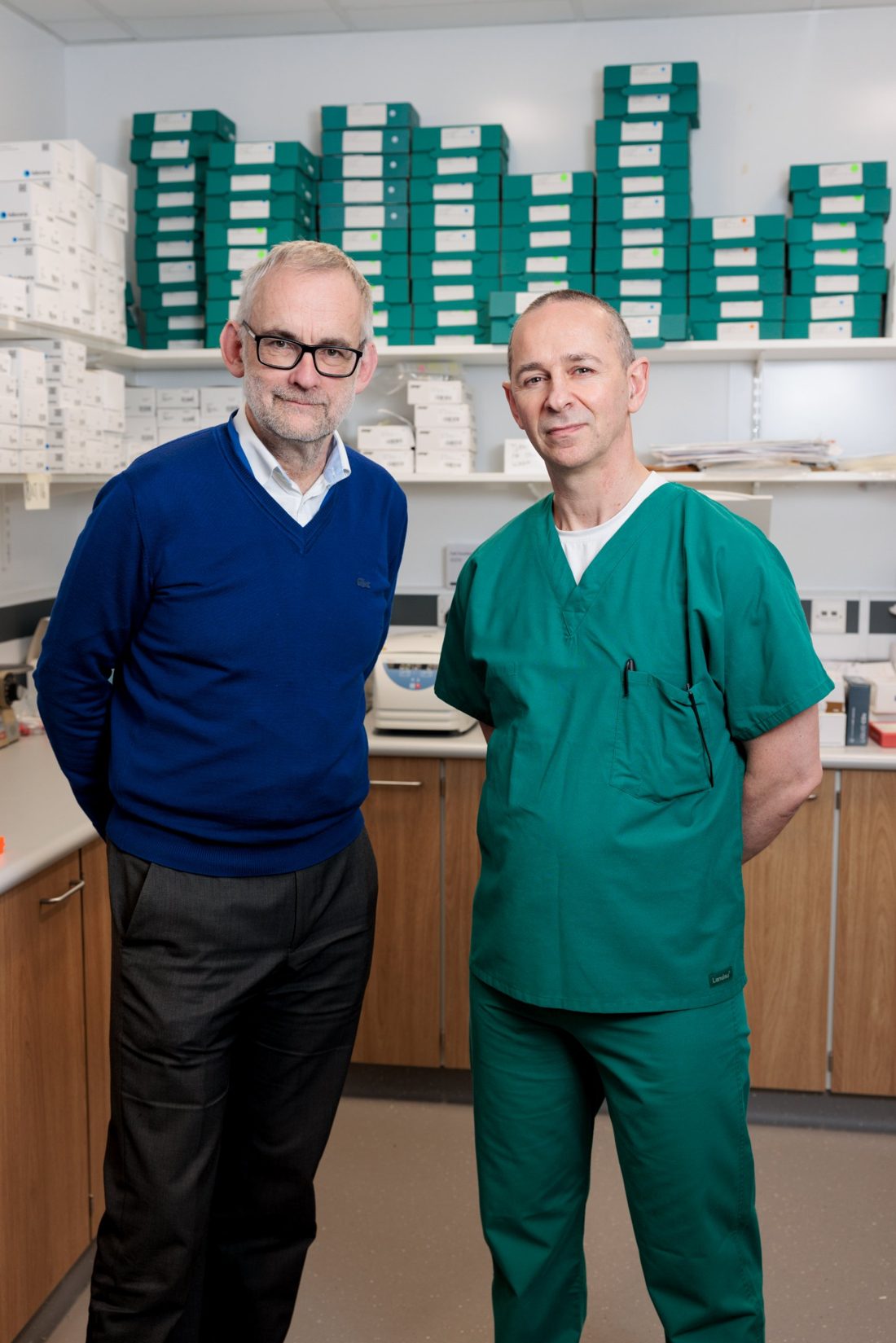
Dr Séamus Coyle
Chief Investigator · Consultant in Palliative Medicine, The Clatterbridge Cancer Centre NHS Foundation Trust · Honorary Senior Clinical Lecturer, University of Liverpool
I'm a palliative care doctor. I grew up in Sligo, in the west of Ireland, and trained at the hospital there before my career brought me to Liverpool. I also hold a PhD in cancer cell biology, and today I split my time between looking after patients and research. Every week I see how much it matters to recognise when someone is dying, and how hard that can be. METEL is my attempt to give the people who care for them something better to go on.
Professor Chris Probert
Co-founder · Professor of Gastroenterology, University of Liverpool
Chris co-founded this research with Seamus and brings expertise in measuring the small molecules the body releases in illness.
METEL is carried out with research teams at hospitals and hospices across the UK, and with the many patients and families who have generously taken part.
Get in touch
If you are taking part, or your relative is, the research team at your hospital or hospice is the best place to start. For general questions about the study:
The METEL research team
The Clatterbridge Cancer Centre NHS Foundation Trust
ccf-tr.researchofficers@nhs.net
If this is a difficult time
Reading about dying can bring up difficult feelings. You don't have to manage them alone.
- Marie Curie Support Line
- 0800 090 2309
- Macmillan Support Line
- 0808 808 00 00
- Samaritans
- 116 123